

Workers in Informal Employment: Organising and Bargaining Collectively
- FREE
- 3 h 18 min
- Englisch
- Interdisziplinär, Politikwissenschaften, Sozial- und Gesellschaftswissenschaften, Wirtschaftswissenschaften
- mit Zertifikat
What is the course about?
This course offers a platform to analyse and discuss the political economy of informal employment and forces driving it. Our focus is on worker collective power and specifically on strategies for collective organising and bargaining in spaces where worker rights are commonly denied.
Across the four content chapters, we will get to learn more on themes such as: workers in informal employment organising and bargaining collectively to resist and overcome their exploitation; the power structures and forces that drive and sustain informalisation, and critical reflections on questions of worker collective power and action, including collective bargaining.
Check our trailer here.
The Global Labour University Online Academy is moving to a new platform.
Details about the new platform will be provided shortly. Meanwhile, we strongly encourage you to complete this course by 15 June 2026 because your progress will not be transferred to the new platform.
Iversity will automatically generate a Certificate of Participation as soon as you reach 80% completion rate. We look forward to seeing you all on our new platform.
Key concepts
Informal employment, informalisation of work, political economy of labour, key drivers of informality, precarity, collective representation, worker collective power, and collective organising and bargaining.
Course materials and workload
This course has 4 content chapters. A chapter contains a series of units; each unit is composed of one video lecture, two quiz questions, one exercise, one key reading (the link of which is provided right under the video) as well as additional readings (under the Additional Materials tab). All the course materials, including video scripts, can be downloaded and used offline. Zoom workshops with the course experts are recorded and added to the course content for those interested in going deeper into the issues discussed in each video lecture.
The estimated workload for each chapter is about 8 hours.
Course certificates
Certificate of Participation (CoP): can be obtained for free once you have completed 80% of the course.
Certificate of Accomplishment (CoA): can be issued only by the Global Labour University Online Academy. For details on the requirements, read carefully the information in Chapter 1, Unit 2.
Course content
Kapitel
1
Course Introduction
Kapitel
2
Organising and bargaining against all odds: stori…
Kapitel
3
The political economy of informal employment: unm…
Kapitel
4
Workers collective power: forms of collective rep…
Kapitel
5
Organising and bargaining against all odds: stori…
What will you learn?
Upon completing this online course, the course participants will be able to:
- understand how various groups of workers in informal employment experience precarity; analyse the factors that constrain and facilitate their collective action; as well as draw analytical insights on the conections, similarities and differences from such actions;
- apply the arguments and learnings from the case studies and argue on the merits of alternative strategies from those currently pursued;
- understand the political economy of informal employment, the power relations, forces, and discourses that drive and sustain the informalisation of work and apply this analysis to their own context; and
- examine the concept of workers’ collective power, and challenge dominant narratives and terminologies that undermine the project of building such power.
What is the target audience?
workers, trade unionists, labour and other activists, labour researchers and practitioners, NGOs, students, media and others.
What prior knowledge is required?
This is a multi-disciplinary course drawing on the fields of social, political and economic sciences. It is at the level of a Masters’ programme, but the concepts are explained in an accessible language and illustrated through examples. Therefore, it is also possible to participate in the course using the skills and knowledge acquired. The course requires a working level of English.
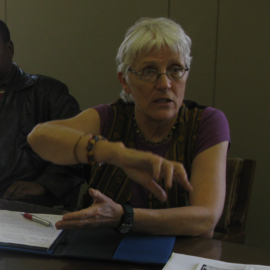
Course instructors











Ausgewählte Bewertungen
Gesamtbewertung 4.2 (35 Teilnehmer)
Informal Sector its the most contributor to GDP of many countries across the continent.
The course were presented by very resourceful lectures and that was a win for me. I am unable to point out any negative on the course setup, well done GLU and keep up the good work.
Very satisfying
More time for causes
A learning opportunity to get the grand perspective over the informal workers
The course is package of learning on informal economy and Informal workers struggle with lessons
I actually like all the videos and chapters, which are very much articulated, short, but informative
Le cours est riche en expérience de lutte
L'informalité n'est pas une fatalité pour autant que les acteurs de ces secteurs prennent conscience que le réél pouvoir n'est pas entre les mains de ceux qui croient le détenir, mais plutôt dans la conscience collective que les travailleurs ont de pouvoir bâtir leur propre destin
Deepening Understanding of Informal Work, Inequality, and Worker Protection
Main Takeaway: A key takeaway is the importance of strengthening worker rights, formalization, and collective organizing and bargaining in addressing inequality in informal and platform-based economies. Feedback Text: This course has significantly deepened my understanding of workers in informal employment and the structural inequalities they face across sectors. It highlighted that informal employment is widespread, persistent, and embedded in modern economic systems, forming a large share of the global workforce while remaining largely outside legal and social protection. The course emphasized that informality is driven by structural factors such as weak labour protections, corporate practices, gender inequalities, and unequal power relations. It also reinforced that informal workers especially women, are disproportionately concentrated in the most vulnerable and low-paying forms of work, often lacking access to rights, services, and representation. Importantly, the course demonstrated that informal workers are not passive but actively organize and bargain collectively to improve their working conditions. Through practical case studies, it showed how collective action and worker organizing can enhance safety, dignity, wages, and access to social protection even in highly informal contexts. These insights are directly relevant to my work and strengthen my ability to design inclusive, rights-based, and sustainable interventions that support vulnerable workers and promote equitable development.
New strategic theories I learnt are great.
I wish we had more time.
Informative and of high standards
Informal workers are more than 90% in country like India.They are increasing world wide with security of employment, devoid of social security. Unionisations many times difficult as they are mobile,for instance the construction workers in India.New forms of workers such as the gig or platform workers are on rise and are highly vulnerable.The topics covered are highly informative and lectures are of high standards.They can be helpful for those who are working on improving the quality of life of the informal workers accross the globe.
informal sector workers collective bargaining and organising
coming from a country where majority of workers are in the informal sector, this course has successfully highlighted the challenges and possible solutions in informal work, thus equipping me with information that is sharpening my skills in advocacy and negotiation
Power of Unity
It's great strategies and uñitely fought against Injustice. I gained lot of things from various union.